The world is a much smaller place than it used to be. Not by size, but by speed and ease of travel and communication. Because of that we wanted to explore how technology has changed marshalling and our motorsport world.
Thanks to blogs, websites, volunteering sites, Facebook, Instagram, and every other platform out there, the ability to marshal at a different circuit has become a lot easier, and the process has become more streamlined. Marshalling itself has also seen great change as a result of advances in technology. From an enforced pivot to signing on online before an event, to how we signal to drivers using light panels, and even how race control receive report forms.
But how much has it changed over the years? We took a look back over our short history to see how it had changed.
How Technology Has Changed Marshalling
A first trip out of the region
When we first started out marshalling, to be able to marshal a weekend at Brands Hatch, a circuit within the UK but over 200 miles from our home circuit of Oulton Park, you had to either ring the circuit office or crawl through hundreds of pages on a website to find the Chief Marshal’s details. You then had to contact them to let them know who you are, when you are planning your visit, and what your experience level is.
You would then hope that all that information was inputted correctly, and that tickets would arrive through your door in time for the event. The first sign that your weekend was going ahead was an email landing in your inbox, followed by the tickets about two weeks before the event.
Only then could you book your leave, plan your journey, and get everything in order. Next was hoping that when you got to the circuit entrance the tickets were valid and your wristband was right.
It was a bit of a rigmarole, but with the use of technology, this process is much easier. 99% of all events up and down the country can be found on an electronic volunteering system where, with the click of a button, you can volunteer and plan for all of your events for the season, and see what meetings you have already volunteered for. The most complete of all these volunteering databases is the BMMC one, as it collates race events from the different clubs and circuits, and includes different disciplines such as karting, sprints, and hillclimbs.
These databases also hold information about your grade, experience and contact details that are passed on automatically to the chief marshal for the event, rather than having to manually send these to them yourself.
There is no trawling for contact details, or hoping you are remembered, and you have a great indication you are going. When tickets are emailed to you it is the final seal of approval that you are off to the event.
Overseas marshalling
Marshalling overseas is the biggest winner from technology. Whilst there is no international database (though that is a cool idea) having the ready access to the contact details that you need to marshal abroad has become a very quick process.
The first time we wanted to marshal in Belgium at the Grand Prix in 2018, we had heard through the grapevine that someone knew how to marshal over there, and that if we spoke to them they could get us the right form to fill out and the right contact details.
Even when all that was submitted and we were driving down into Stavelot, for sign on, we still had a feeling of ‘Did they actually get my volunteering application?’ – Again, thankfully they did.
When we visited Le Mans in 2019, it was by complete luck that we bumped into a French marshal, Steph Tartiere, who was able to guide us through the process, talk to their Post Chief and ensure that all was right for us to attend.
Now the process is a lot easier, as most countries now have a volunteering database that can be tapped into, and is usually rather easy to set up an account with.
That being said, if you are unable to find a database there is one surefire place you can find the information or person you are after.
In the Facebook group, Flag Marshals of the World, you can post a question about how to marshal at just about any circuit in the world, and someone will be able to tell you. For example, if you wanted to marshal in America for the Petit Le Mans or Daytona 24 hours, hundreds of people will directly tag the chief marshal into your post, or give you their email address.
No more circumstantial opportunities, trawling through websites, knowing the right person or being in earshot of a conversation. You can simply say, “I would like to marshal here,” and wait for people to help you out. That’s the power of the marshalling community; all are on hand to help make your trip happen for you.

Some changes had to be made
We all remember how the Coronavirus pandemic of 2020 led to an understandable delay in the start of the racing season in the United Kingdom, but it also brought about a number of enforced changes. One of these was a change to the process of signing on for an event. The traditional way of meeting up with the chief marshal and queuing up to manually sign a form, and fill out emergency contact details, was not possible during 2020.
Instead, clubs had to utilise online sign on, where you would fill in these details electronically before an event. This has now become the norm, and the physical check in process is more of a formality to confirm attendance and receive your post allocation for the day or weekend. Clubs such as the BRSCC and MSVR actually have a dedicated marshal sign on tab on their event pages, and others use send out a link via email prior to the event.
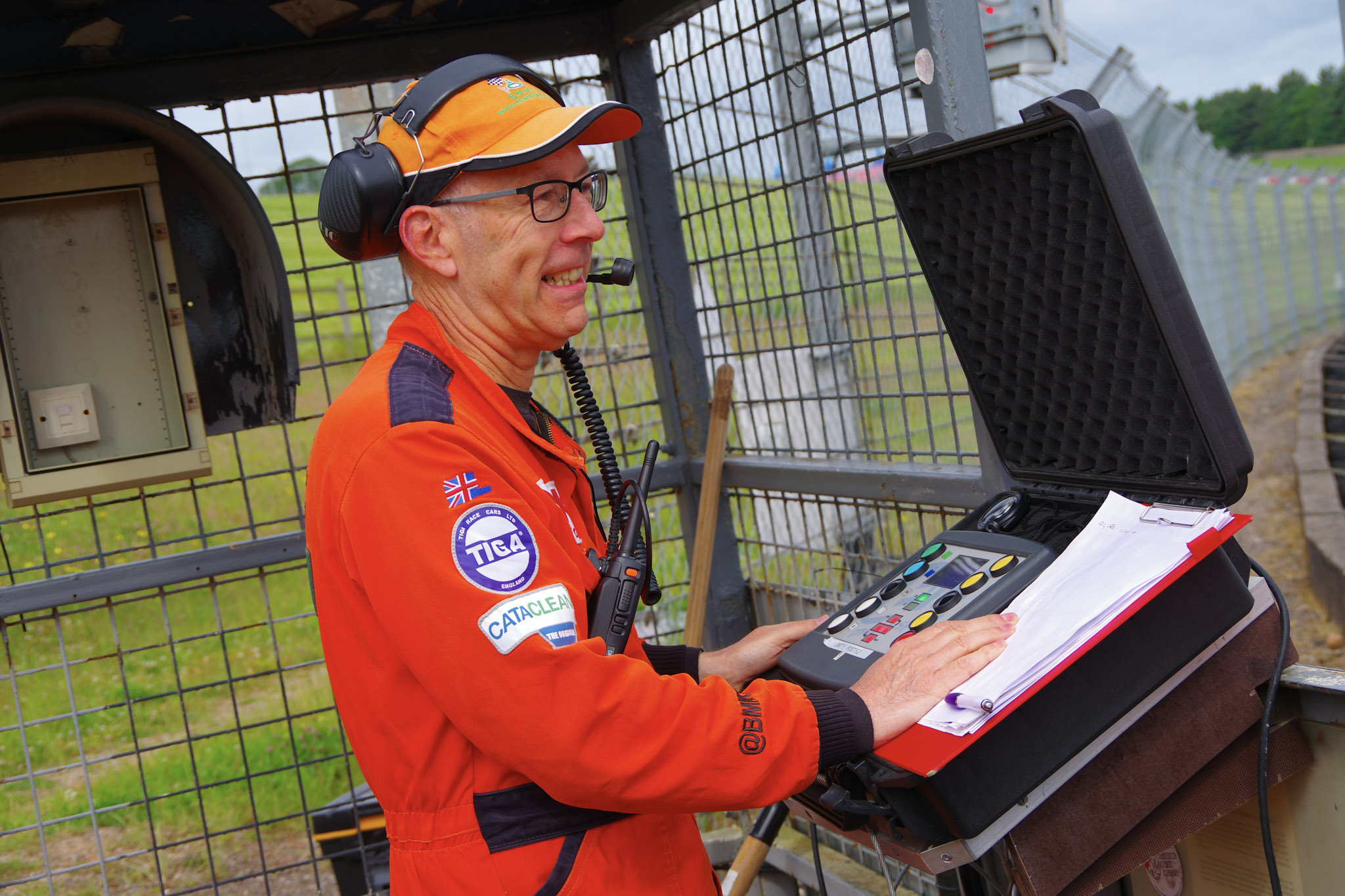
Another necessary change was how marshals signal drivers using lights. In 2022, the British Motor Sports Training Trust announced that FIA spec light panels were to be installed at all Motorsport UK licenced circuits. These panels are the same used at Formula One circuits, and the system is clever in how each panel communicates with adjoining panels, where a single yellow signal is automatically shown on a panel preceding a double yellow signal.
These panels can also be controlled centrally from race control. Whilst we believe that the traditional flags will always have a place in marshalling, the updated system is operationally superior to the previous one, as they are much more clearly visible. Having more visible lights signalling drivers can only be safer for everyone!

How technology has helped practically
Whilst we know that phones and other devices should not be used when on active duty, they have become increasingly important tools for marshalling. Whether that be downloading tickets to be scanned on arrival at the venue, saving a copy of the timetable to be accessed through the day, getting the timing screen up during an endurance race to see who is in the lead, or reading your favourite marshalling based blog, phones can be a great help to the marshalling day.
Technology has also changed things on an organisational level. Reports from post chiefs round the circuit are often no longer manually picked up by the course car, but rather are sent in via email. Important messages about the event such as changes to the timetable, amendments to programmes, grids sheets and judicial reports are now posted on online noticeboards, rather than physical ones.
The ever-reliable weather apps can also help us prepare accordingly for the atmospheric conditions we can expect at the circuit. For example, if you are going in to a weekend and see that it is going to be extremely warm, you will know to pack extra water. Conversely, if you see a forecast giving heavy rain and cold conditions, you will know to pack waterproofs and extra clothing to try and stay dry and warm.
In Summary
Marshalling at a different circuit, whether in your own country or elsewhere around the world no longer requires thousands of hoops to jump through. It is a much more streamlined and friendlier process.
Technology and the digital age has connected and opened more doors for everyone, as well as changing and updating some more traditional elements of marshalling. Whether these changes are for the better or not is a matter of opinion, but the increase in use of technology to increase safety for marshals and competitors is always welcome.
All the technology aside though, if you are ever looking to marshal elsewhere, or struggling to find where to sign on for an event, head to one of the groups and ask the question as someone will always be willing and keen to help you out, and you may make a new friend or two along the way.